A New Australian Design Story Is Taking Shape — And The Feeling Designer Wants to Name It
 March 15, 2026•Jess Watson
The Feeling Designer began as a growing recognition that a different kind of design practice was already taking shape in Australia, and that it deserved language, visibility and somewhere to gather.
The Feeling Designer did not begin as a polished business idea. It began as a growing recognition that a different kind of design practice was already taking shape in Australia, and that it deserved language, visibility and somewhere to gather.
For many years, its founder, Jessica Watson, had felt a tension between the version of design most often rewarded by the industry and the kind of work she found herself moving towards. Like many designers trained in traditional fields, she knew the language of craft, brand, visual communication and presentation. But she was increasingly drawn to something broader. Strategy. Facilitation. Participation. The social and cultural conditions sitting underneath a brief. The human realities that shaped whether a design would truly land, or simply look resolved on paper.
From Personal Phrase to Shared Pattern
The phrase The Feeling Designer first appeared while Jess was trying to define her own practice. It emerged during that familiar period of self-questioning that comes with building something independently. What is the work, really? What makes it distinct? Who is it for? At first, the phrase felt personal. Then it began to feel too shared to belong to one person alone.
The questions that started it all
What is the work, really? What makes it distinct? Who is it for? These questions are rarely answered in a single sitting. They unfold over years of practice, conversation and quiet recognition.
Looking around, she realised she had always been drawn to others asking similar questions about their own careers. Designers from communication design, media, marketing, urban design, architecture and adjacent creative disciplines were also pushing at the edges of what their training had prepared them for. Many had come through traditional studio or agency pathways, yet felt restless inside them. They wanted to work on the bigger picture. They wanted to understand people more deeply. They wanted to shape work with others, not simply produce polished outputs on their behalf.
That recognition led to a small dinner in Melbourne. Around the table sat seven design practitioners at different stages of their careers, from emerging creatives to business owners. What connected them was not a single job title, but a shared sense of being slightly outside the traditional mould of the design industry. They spoke about not quite fitting the usual studio culture. About wanting to build practices that could hold more complexity, more participation, more strategy, more care. About feeling that their role as designers could be larger than what the industry often allowed.
A shared instinct
That dinner became an early proof point. It showed that this was not simply a personal brand or a clever phrase. It was a shared pattern. A set of instincts. A growing movement of designers trying to expand the role of design in Australia.
At Its Core, The Feeling Designer Names a Shift Already Underway
It speaks to designers who know their role is not limited to making things polished, persuasive or visually compelling — even though those skills still matter. It speaks to those interested in context as much as outcome, and in process as much as presentation. It is for designers who are asking different questions about power, authorship, lived experience and who gets to shape a brief in the first place.
The Tension Underneath It
For its founder, those questions began early, and are still ongoing today. Design education often felt too narrow, too segmented, too focused on individual output. Students were taught to respond to briefs quickly, convincingly and often in isolation. There was far less room to interrogate where the brief had come from, whose worldview shaped it, or what other forms of knowledge might need to enter the room. Even then, she was drawn to the parts of practice that sat just beyond the formal edges of design itself: strategy, futures, systems, social context.
That tension sharpened in professional practice. After returning from China and trying to re-enter the Australian design industry, she found that her portfolio did not quite fit the expected mould. The depth of her work was in the thinking, the framing, the process and the intention behind it — but those qualities did not always translate neatly into the kind of visual shorthand studios were used to scanning for. The gap was not a lack of ability. It was a mismatch between what the industry knew how to recognise and where her strengths actually sat.
A deeper question
Who gets to decide what good design is? If design is constantly judged within a narrow professional frame — by a small group of people trained to value certain kinds of outputs over others — then important knowledge is left out.
The people most affected by design decisions often remain outside the process, consulted only lightly or much too late. In response, The Feeling Designer argues for a wider understanding of design — one that still values craft but also values facilitation, listening, translation, relationship-building and shared authorship.
What "Feeling" Means
This is where the word feeling becomes more exact than it first sounds.
Within The Feeling Designer, feeling is both a way of being and a way of practising. It refers to designers who have moved into deeper inquiry, beyond surface aesthetics alone, and who have begun asking more serious questions about power, participation, collaboration and cultural context. It also refers to an active sensitivity: an ability to be in touch with one's own instincts, body, politics and responsibility in the room.
Feeling is not softness without rigour
It is a method of attention. A Feeling Designer understands that people may not always describe their needs in neat design language. More often, they will speak about what they want life to feel like. How they want to belong. What has been missing. What has been ignored. What a better future might look like from where they stand.
For The Feeling Designer, that is not vague emotional material sitting outside the brief. That is the brief.
The role of the designer, then, becomes more generous and more demanding at once. It is no longer only to interpret a client's request into an attractive outcome. It is to hold space for complexity, to find the gold in what others are expressing, and to translate that into forms, systems, places and experiences people can genuinely see themselves in. It is the meeting point of purpose and polish — not a choice between them.
Why Australia Matters
The project is also explicitly Australian in its focus. That is not incidental. The Feeling Designer takes the view that Australian design practice needs a deeper conversation about place, history and cultural inheritance. Too often, local designers are still trained to look outward first, drawing references from London, New York or the broader global design canon before paying close attention to the stories, responsibilities and ways of seeing already embedded here.
For The Feeling Designer, the challenge for the dominant design culture in Australia is not simply to acknowledge that, but to become more fluent in it. Not as a token gesture, but as a real shift in how place is understood and how collaboration occurs.
A distinct cultural project
It is not only about careers. It is about helping shape a new Australian design story — one that starts here rather than borrowing its imagination entirely from elsewhere. One that takes seriously the idea that brands, buildings, services, exhibitions, events and public spaces are all cultural artefacts, and that they communicate story, values and belonging whether they mean to or not.
Why It Begins with Listening
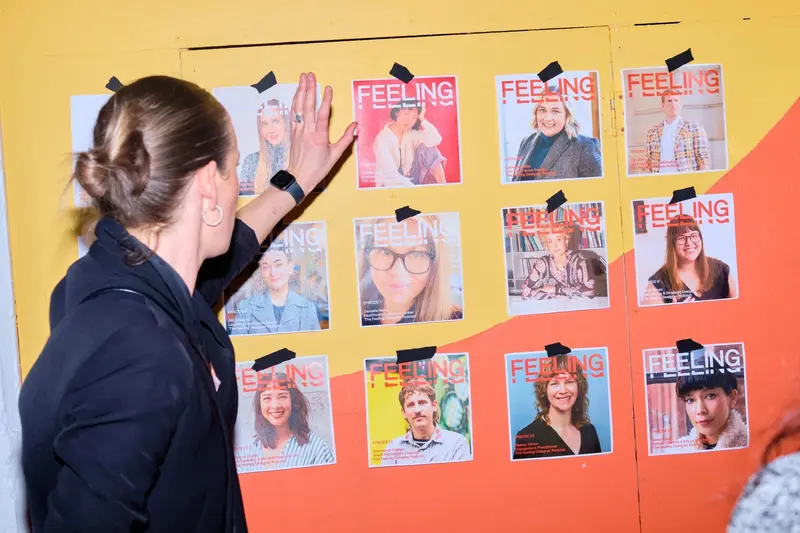
The first public expression of The Feeling Designer is a podcast, and that choice says something important about the movement itself. It begins not with a fixed framework, but with listening.
Its founder had already been having many of the same conversations privately. Younger designers and students kept asking how to get into more participatory, purposeful work. They wanted to know what to study, who was doing this in practice, and whether there was a pathway beyond the traditional studio model. The answer, she realised, was that there is no single neat pathway. Most people build this kind of practice gradually, through instinct, politics, curiosity and a series of moves that feel more honest than the last.
"I kept having these coffees with younger designers who were asking the same questions I had once asked myself. I realised the stories needed to be shared more widely. Not just for inspiration, but so people could actually see a path forming in front of them."
— Jessica Watson
That is the logic of the podcast, and of The Feeling Designer more broadly. Visibility creates legitimacy. Legitimacy helps people back themselves. And once people can recognise a practice, they can begin to gather around it, teach it, commission it and grow it.
Mentoring with intention
The movement is also beginning to articulate a mentoring offer — one shaped specifically for designers moving beyond craft alone. This is not about portfolio polishing or standard industry advice. It is about helping emerging Feeling Designers work out what kind of participatory practice they want to build, where their interests sit, and how to navigate workplaces that may value their emotional intelligence and generosity without always knowing how to protect it.
Naming Something Before the Industry Catches Up
There is risk in naming any movement before the wider industry has fully caught up to it. The project's founder is aware that some will see the audience as too niche, the language as too soft, or the ambition as outpacing the market. Others may question why design is the entry point at all, rather than the broader fields of social innovation, community-led practice or co-production. But that tension is part of the point. The Feeling Designer is not claiming to invent this work from scratch. It is helping make visible a set of practices and practitioners that already exist, but have often remained scattered, under-recognised or difficult to name.
"I know some people will think the audience is too small. But I also think that if something is already happening, it deserves language. It deserves visibility. And if the market is not fully there yet, that does not mean the movement is not real. It just means there is work to do."
— Jessica Watson
A Name, a Place, a Movement
The Feeling Designer is still new, and still finding its shape. But the impulse behind it is already clear. It is a platform, a conversation and a gathering point for designers who want to practise in more participatory, relational and feeling-led ways. It is a place to celebrate those already doing the work, and to make that work easier for others to find. It is a signal to emerging designers that there may be more room for them than the traditional industry suggests.
Most of all, it is an attempt to name something many people have already been feeling for a long time: that design can be more human, more shared, more connected to place and more accountable to the people it affects.
For those who have felt it
For those who have felt that instinct quietly building in the background of their careers, The Feeling Designer offers something simple but significant.
A name for it.
A place for it.
And, perhaps, the beginnings of a movement around it.
That work begins here.